We made benches
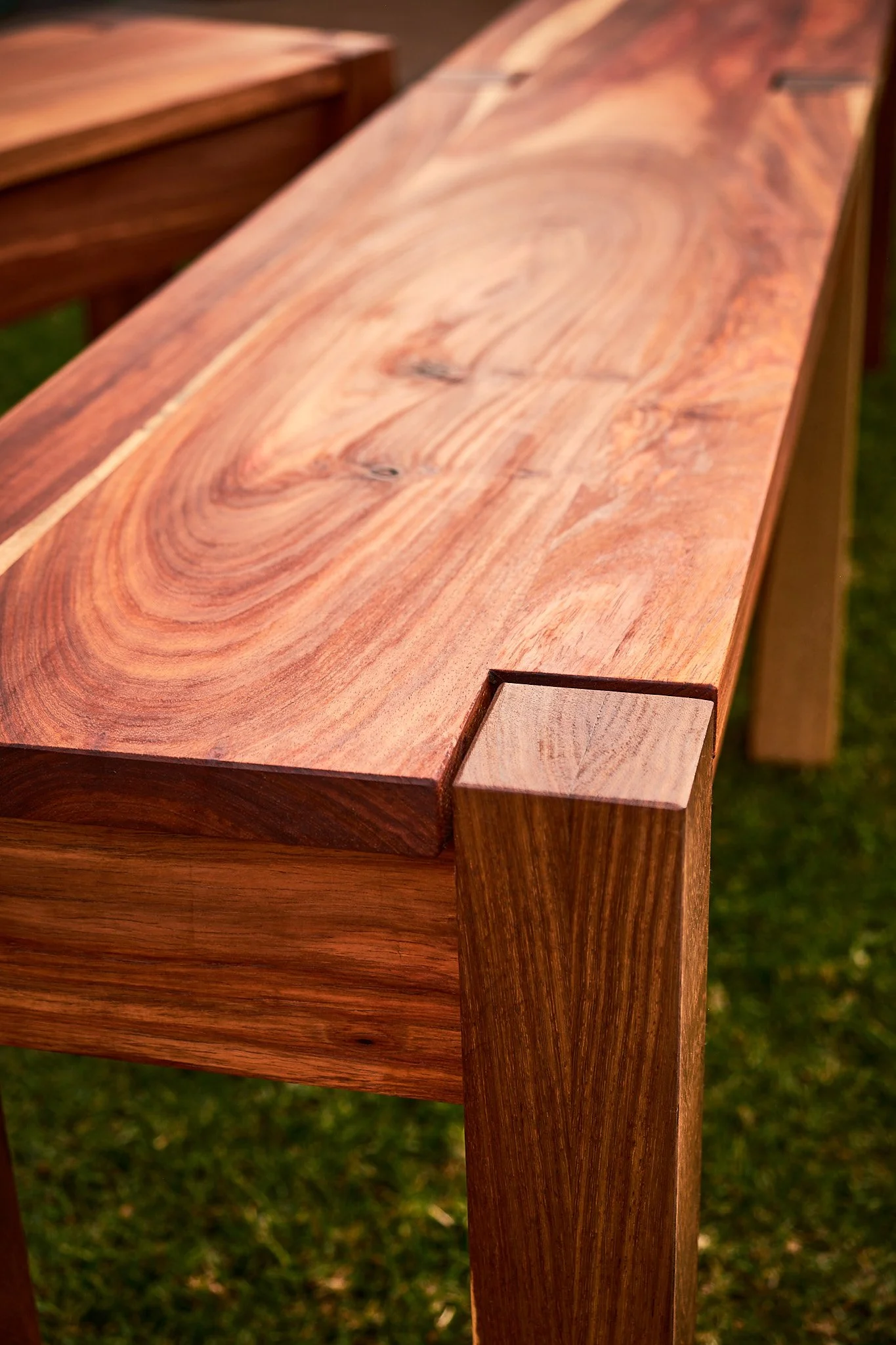
We present a pair of Kiaat solid wood benches we designed and built for a customer.
The design of the legs are unique and were made to match a very large Kiaat dining room table that they already owned. During the design phase we submitted the first drafts of the 3d renders to the customer without saying a word about matching the table leg design and they picked it up immediately from the images we sent them and they were over the moon with what we came up with!
Of course our concept delivered its own challenges during construction as we couldn’t just affix a flat top to the frame anymore and we needed to come up with a solution to show the upper face of each leg. I lay awake at night trying to come up with a plan and finally settled on the solution you see here where we first installed a narrow section of wood that ran from end to end on each bench and then we added narrower sections (4 per bench) between the legs resulting in six square recesses, accommodating the legs. The trick was to allow a similar spacing around the legs for each section of wood added to the laminations.
The above was preceded with the construction of the framework that was to accommodate our brilliant, if we do say so ourself, conundrum that was to become the rear end placement area or otherwise known as the seat. Traditional mortise and tenons between the aprons and the legs held it all together and there happened to be 14 per bench for a 28 in total (lots of chisel practice). This resulted in a frame you could dance on, you could invite a friend or two onto one of these guys and boogie to your heart’s content with full confidence.
Did you know that business cards make really good fillers for tenons that sit a bit loose in a tenon? Not that we needed to fettle any one of the tenon to mortise joints as they all came out brilliantly with a perfect friction fit! But it really does work well if you happen to have a loose fit, which we didn’t on any of the joints, and come to think of it business cards are effectively thin slithers of wood after all.
Maybe we should write something about fixing loose tenons at some point………..🤔
The wood used is a Southern African hardwood species called Kiaat - Pterocarpus angolensis - sometimes called blood wood due to its red sap that is also responsible for these amazing colours and patterns. Around here we can buy Kiaat in two “makes” if you will, at the supplier it’s either called all brown or brown/white. The stuff I used is of the brown/white ilk which also happens to be the cheaper of the two. I love working with this stuff as it’s almost impossible to tell what it will look like once planed up and dimensioned whilst still in its raw, unprocessed form. Of course not all humans like surprises and this does include some customers, so the all brown tends to be more in demand and is thus the bit more snobbish and expensive form. Honestly I would have no issues if the tables were turned and the bicoloured version was more expensive as it would remain my favourite of the two. However if you tell my supplier this, I will know whom to have a heart to heart with.
The smell, oh the smell! Kiaat has a very distinctive, spicy smell while its being worked which likely ranks amongst my favourite top 5 smells along with coffee and frying bacon. It is truly a pleasure to work with.
Anyway here they are and the customer loved them, we hope you do too.
I’m off to have coffee or fry bacon or take a few shavings off a Kiaat plank with a hand plane.